
Investing in property in Rome is, in principle, already a smart decision. We are talking about one of the most attractive European and global capitals, with a market that in recent years has shown steady growth. The appeal of Southern Europe, a lower cost of living compared to other capitals, the Mediterranean climate, and the overall quality of life make Rome a highly desirable destination. The result? Demand for property often exceeds supply, which continues to push prices upward. At the same time, relatively favourable mortgage conditions have contributed to keeping the market dynamic and active.
There is more. In preparation for the Jubilee 2025, approximately €12 billion have been invested in infrastructure, urban regeneration and public services. Rome is currently experiencing a phase of renewal that is attracting both small and large investors. If the choice is made wisely, you are not simply buying a property in one of the world’s most desired cities — you can build a solid and profitable business. The challenge, however, is that the Roman real estate market is complex and difficult to read for non-professionals.
In this article, you will gain an overview of Rome’s areas and their market dynamics, discover the main pitfalls to avoid when purchasing property in the Capital, and understand why a strategic approach is essential to turn a purchase into a successful investment.
The Roman real estate market: not all “Romes” are the same
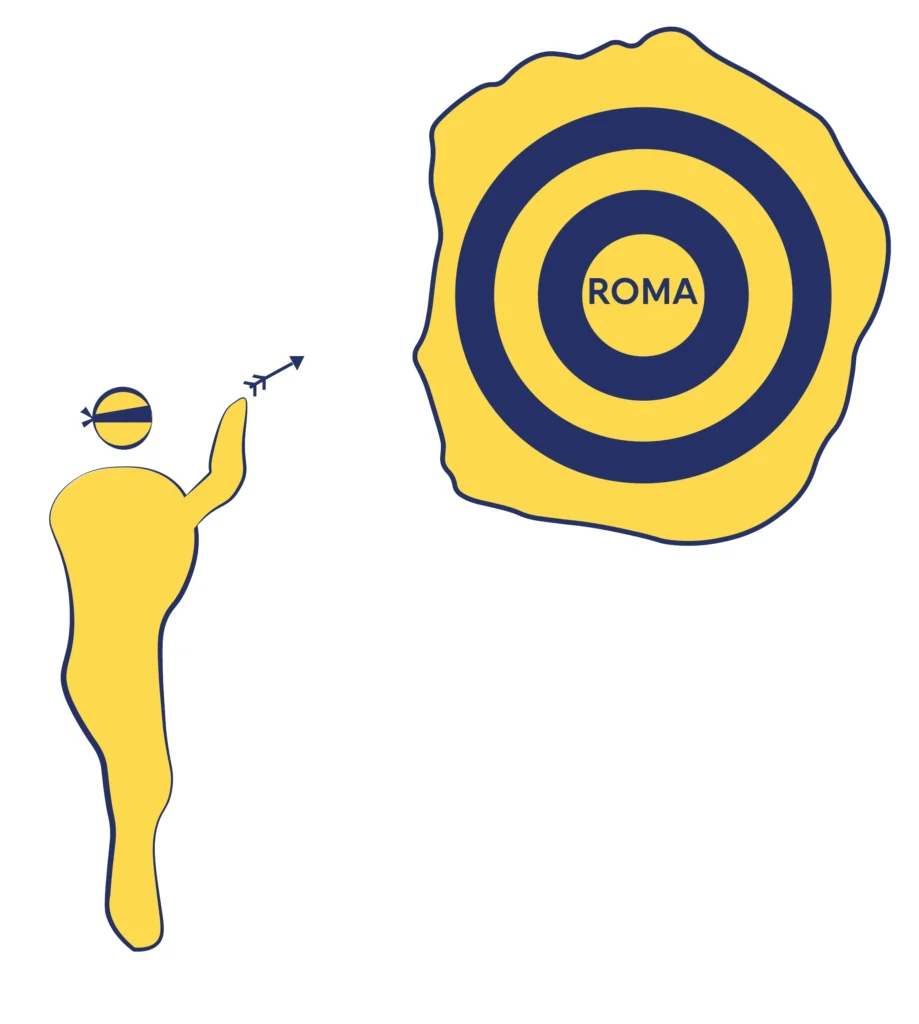
The location cannot be selected blindly.
Rome is not a homogeneous city. It is made up of historic districts and modern neighbourhoods, each with different market dynamics and potential, shaped by a layered urban fabric developed over centuries.
The Historic Centre records average prices between €8,000 and €10,000 per sqm and mainly targets high-spending buyers and investors in the premium hospitality sector. Returns can be attractive, but entry costs are high, and properties are often destined for boutique hotels or high-end tourist accommodation.
Established semi-central areas — such as Prati, Parioli, Monteverde, Piazza Bologna, Trieste and Monti — remain highly sought after. They offer a strong balance between prestige, services and stable demand, with prices typically ranging between €4,000 and €7,000 per sqm. These areas ensure a diversified clientele and relatively secure investments.
Some of the best growth prospects often come from emerging districts. Rome East — including neighbourhoods like Centocelle, Tor Pignattara and Colli Aniene — is rapidly evolving, with values roughly between €2,000 and €3,500 per sqm. Rome West and parts of Rome South are also showing renewed interest, while well-connected suburban areas such as Axa, Casal Palocco and Infernetto offer quality of life and promising growth forecasts.
Il punto è uno solo: ogni quartiere ha regole e logiche proprie. La scelta della zona incide direttamente sul successo dell’investimento. Quindi è necessario conoscere i servizi e lo sviluppo della zona.
The pitfalls of a real estate operation in Rome
The regulatory maze
The first major critical issue concerns planning and building compliance. In Rome, it is common to encounter unauthorised building works — even minor ones — that can delay or compromise a transaction. Understanding whether an irregularity can be regularised, at what cost and within which timeframe, is crucial. Equally important is knowing the Master Plan, in order to assess the feasibility of subdivisions, mergers or changes of use that may increase the property’s value.
Hidden defects
Structural issues, dampness, outdated systems, noise problems or disturbing contextual factors are often not visible at first glance. Discovering them after purchase means facing unexpected costs and potentially reducing profitability significantly.
The property’s true vocation
Buying without a strategy is one of the most common mistakes. Residential use, long-term rental, short-term letting, subdivision, or change of use — each option carries different regulatory, fiscal and economic consequences. An architect, however, understands which operations are actually feasible, because they can analyse and interpret the Master Plan, Building Regulations, condominium rules and any existing constraints. Identifying the property’s vocation from the outset therefore means not only imagining what it could become, but knowing what can realistically be done — aligning spatial potential, regulations and market demand. A vision that integrates architecture, urban planning and business logic prevents unrealistic choices and economically inefficient decisions. Combined with a tailored and well-directed design strategy, this completes the investment framework.
Professional vision and strategy: the key to a successful investment in Rome
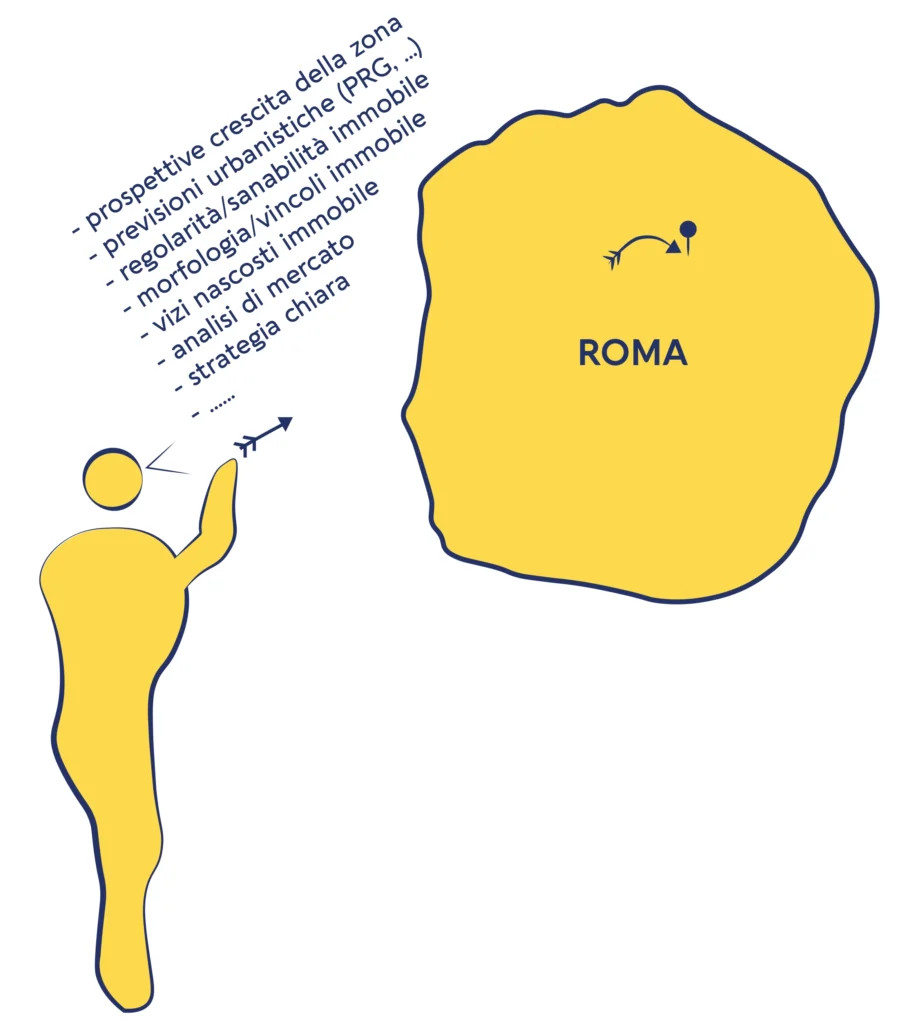
The keys to success.
For a real estate operation in Rome to truly succeed, intuition and generic experience are not enough. A thorough technical due diligence is required to verify planning compliance, regularisable irregularities, hidden defects and the property’s real potential.
However, a strategic vision is also required: you must account for the initial investment and its payback period, while deciding whether to aim for capital gains through a quick resale or to generate rental income. The latter could involve long-term leases at market or rent-controlled rates, medium-term transitional rentals—leveraging the presence of workers and students from prestigious public and private universities—or short-term vacation rentals (choosing the most prudent management model). At the same time, the most effective operation must be assessed: whether a renovation is sufficient, or whether subdivision, merging, or a change of use would be more advantageous — always aligning income objectives, property characteristics and the dynamics of the target market.
A professional with an entrepreneurial approach evaluates costs, benefits and returns, avoiding costly mistakes and identifying opportunities that are not immediately visible.
Without this expertise, buyers risk acquiring problematic properties, underestimating renovation costs, missing value-enhancement margins or choosing the wrong location for their objectives. With the right guidance, however, a purchase can become a truly strategic operation.
Conclusion
Investing in property in Rome can be an excellent opportunity — but only when approached with expertise and vision. In such a complex market, the difference between a mediocre investment and a profitable business lies in the ability to read the context, avoid structural mistakes, and transform a purchase into a conscious and strategic decision.
Are you considering a real estate investment in Rome?
Amnios Architettura can support you with strategic consultancy and tailored design solutions.
Book your free consultation here.