
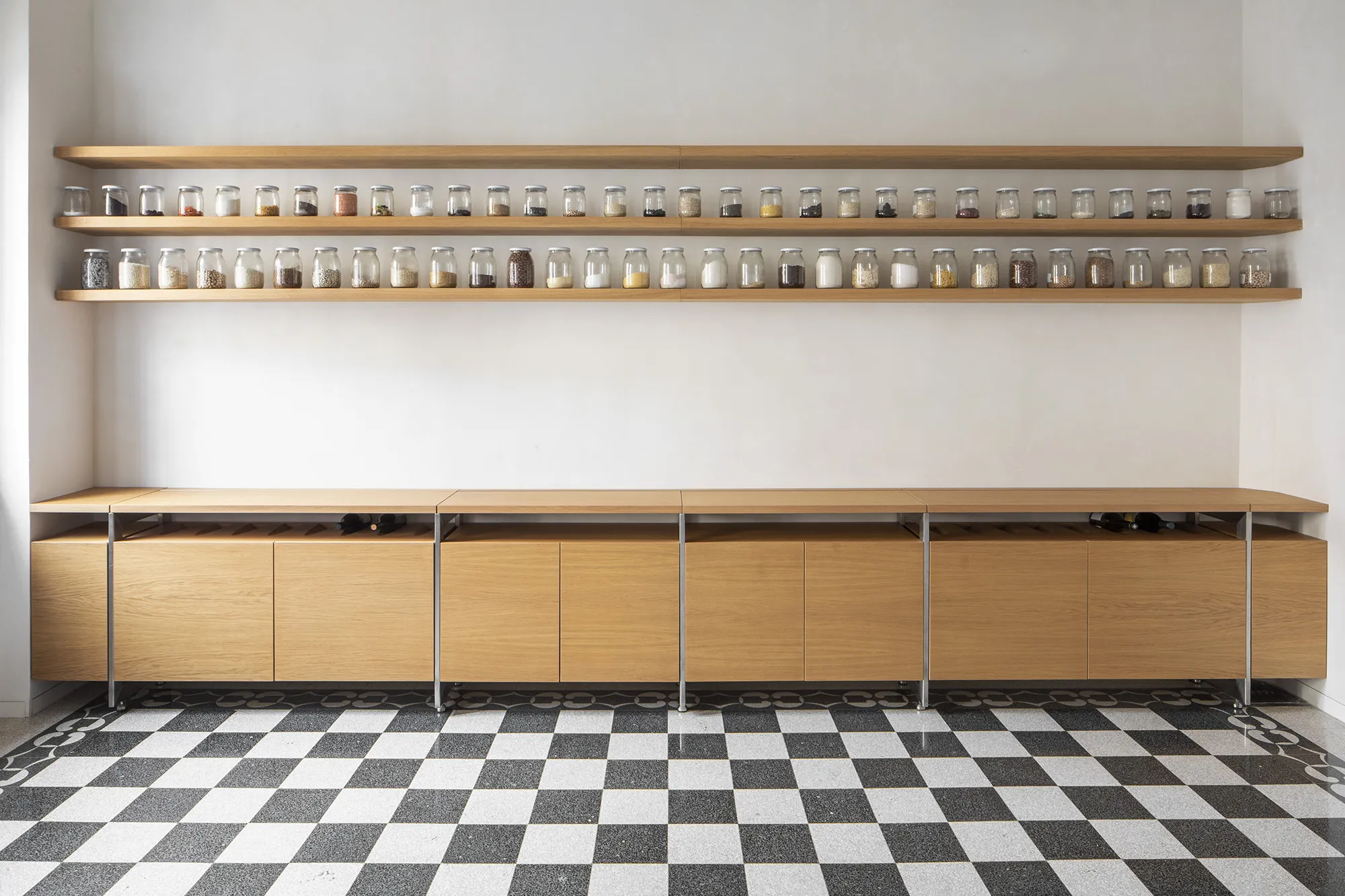
During a renovation in Rome, unexpected discoveries are common. Lifting an old parquet floor or removing a more recent surface can reveal a hidden treasure: historic cement tiles, with geometric patterns and colours that tell the story of the building. At other times, the tiles are already visible — perhaps in a property being considered for purchase or in an inherited apartment. In every case, the question is the same: what should be done when faced with such an architectural element? How can it be enhanced without compromising the demands of contemporary living?
Historic Cement Tiles: History, Roman Context and Enduring Appeal

Diagram showing the handmade production process of cement tiles.
Cement tiles originated in France in the mid-19th century and soon spread across Europe thanks to the invention of cement and hydraulic presses. Unlike ceramic tiles, they were not fired in a kiln but produced by pressing a 2 cm base of sand and cement topped with a surface layer of fine cement, sand and mineral oxides. The tiles were then cured and matured over several weeks. In Rome, their golden age coincided with the late 19th and early 20th centuries, particularly during the city’s Umbertine expansion. Cement tiles were used both in elegant residential buildings in districts such as Prati, Esquilino and San Lorenzo, and in more modest housing developments. They appeared in entrance halls, staircases, kitchens, bathrooms, corridors and sometimes even principal rooms. Their popularity was also due to ease of installation: once laid, they did not require polishing but were treated with linseed oil for protection against stains. They were typically square (20 × 20 cm or 25 × 25 cm) or hexagonal.
The Contemporary Value of Historic Cement Tiles: Material, Memory and Design Identity
Historic cement tiles continue to fascinate architects, designers and homeowners because they offer decorative richness that is difficult to replicate. Each floor forms a mosaic of geometries that creates rhythm and subtle spatial boundaries. Even when faded by time, their colours retain a depth and material quality rarely achieved by contemporary finishes. Originally produced one by one using metal moulds and hydraulic presses, cement tiles are now manufactured industrially. Yet modern reproductions often lack the irregularities and patina that only time and handcrafted production can confer. There is also historical value: a cement tile floor reflects the taste and choices of those who lived there before us. Preserving it means maintaining a tangible link with the building’s past.
Historic Cement Tiles and Terrazzo Tiles: Recognising and Enhancing the Differences
It is not uncommon to find both terrazzo tiles and cement tiles within the same apartment. Traditional terrazzo tiles (often known in Italy as graniglia or Venetian-style marble tiles) are composed of marble chips of varying sizes set within a cement base. In terrazzo tiles, the surface aggregate is generally coarser than the fine pigment layer of cement tiles, and decorative patterns are created using moulds that separate different mixes. Unlike cement tiles, terrazzo tiles are polished after installation, giving them a brighter, more uniform, terrazzo-like appearance. They are often decorated with geometric, floral or Art Nouveau motifs.
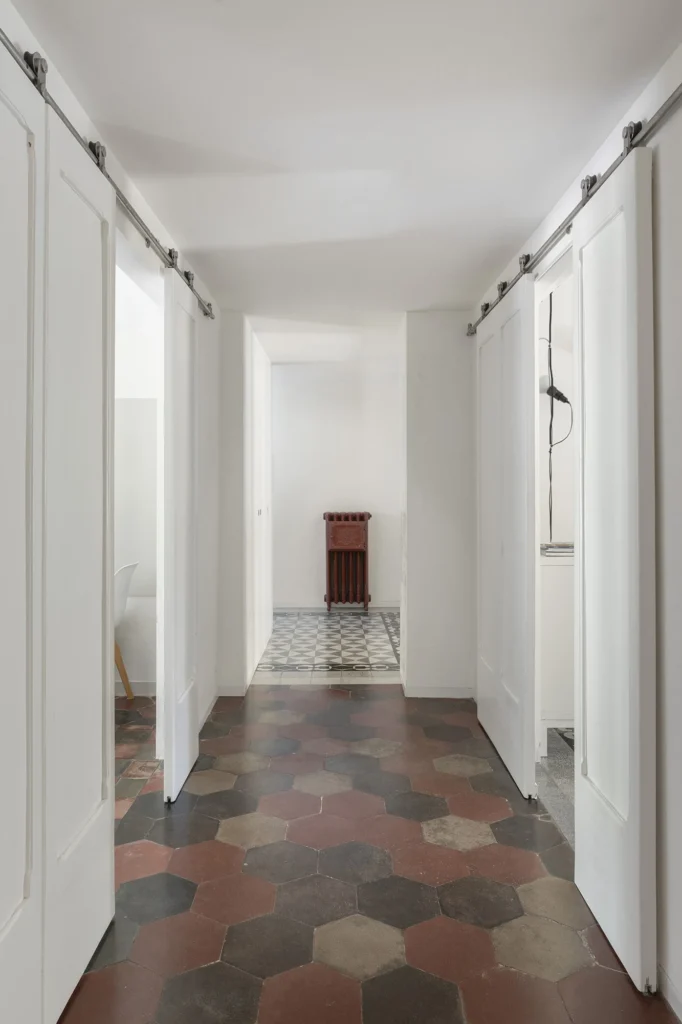
Recovered hexagonal cement tiles in Boutique Holiday Home
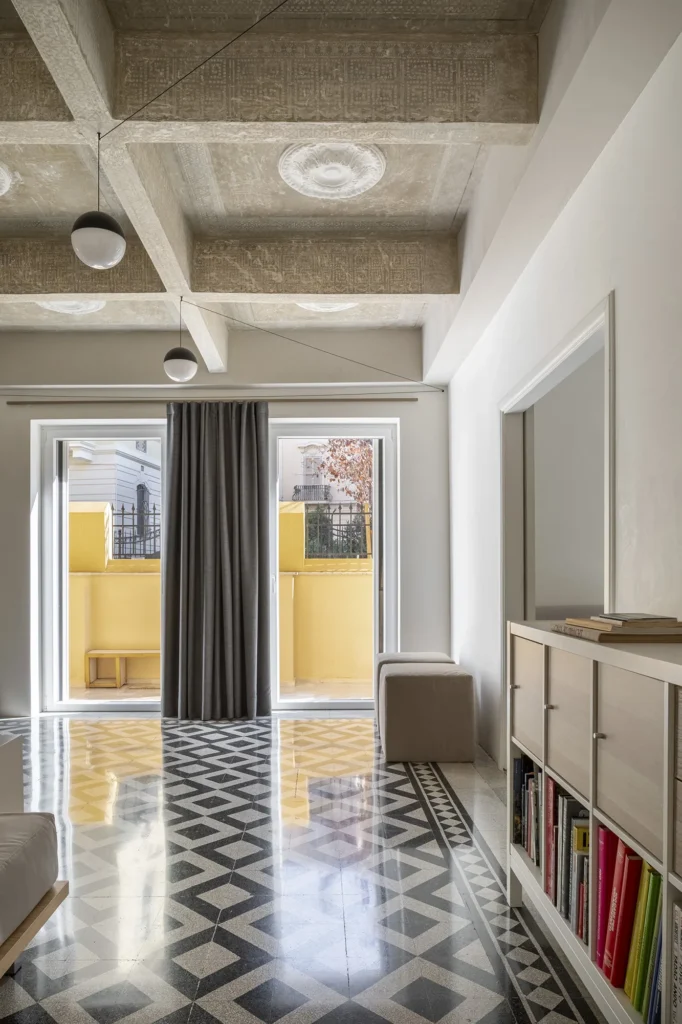
Restored cement terrazzo tiles in Boutique Holiday Home
When faced with this coexistence, the design approach should enhance both typologies without attempting artificial homogenisation. The transition can be emphasised through metal profiles or dividing bands, or this very discontinuity can be used to highlight the functional distinction between spaces. Terrazzo tiles, being more durable and water-resistant, were traditionally used in kitchens and bathrooms, while cement tiles decorated reception and representative areas. Respecting this original logic can offer a meaningful interpretative key for the restoration project.
Conservation Techniques
If the floor requires intervention, the first step is to assess its state of conservation: the extent of the original surface, surface wear in high-traffic areas, accidental breakages, detachments or stains caused by aggressive substances, and any past replacements with different materials. Several options may then be considered: full conservation, partial restoration integrating missing sections, or complete removal in the most compromised cases.
“Cuci e Scuci”: The Craft of Restoration
The 'Cuci e Scuci' technique is essential whenever sections of flooring must be temporarily removed for service installations or repairs. Tiles are extracted with surgical precision, documented and later repositioned exactly as before. The success of this process depends on technical skill and patience, ensuring that the historic material remains intact and legible.
Integrations and Inlays
At door thresholds or where partitions have been removed, tiles are often cut or missing due to previous interventions. In these cases, inlays can be introduced to dialogue with the existing pattern. The most honest approach involves using new cement or terrazzo tiles in slightly different tones, or contemporary materials such as resin, brass or stone, clearly signalling the recent intervention rather than imitating the past. Alternatively, bespoke tiles can be commissioned to replicate the original design, accepting that their “newness” will soften only with time.
Repairs and Surface Treatments
Cracks and chips in terrazzo or cement tiles can often be repaired using mineral-based fillers and colour-matched restoration techniques. After repair, protective treatments — breathable sealers rather than impermeable coatings — help preserve the surface while maintaining its natural appearance.
Constructing New Partitions
One of the most common challenges during renovation is the need to create new walls or relocate existing partitions. How can this be done without destroying the historic floor? The most respectful technique involves precise, millimetric cutting of the tiles along the line of the new wall using wet diamond tools. The new partition is then constructed directly above this cut line. If the spatial layout changes significantly, another option is to dismantle and reassemble the tiles into a new pattern consistent with the updated distribution.
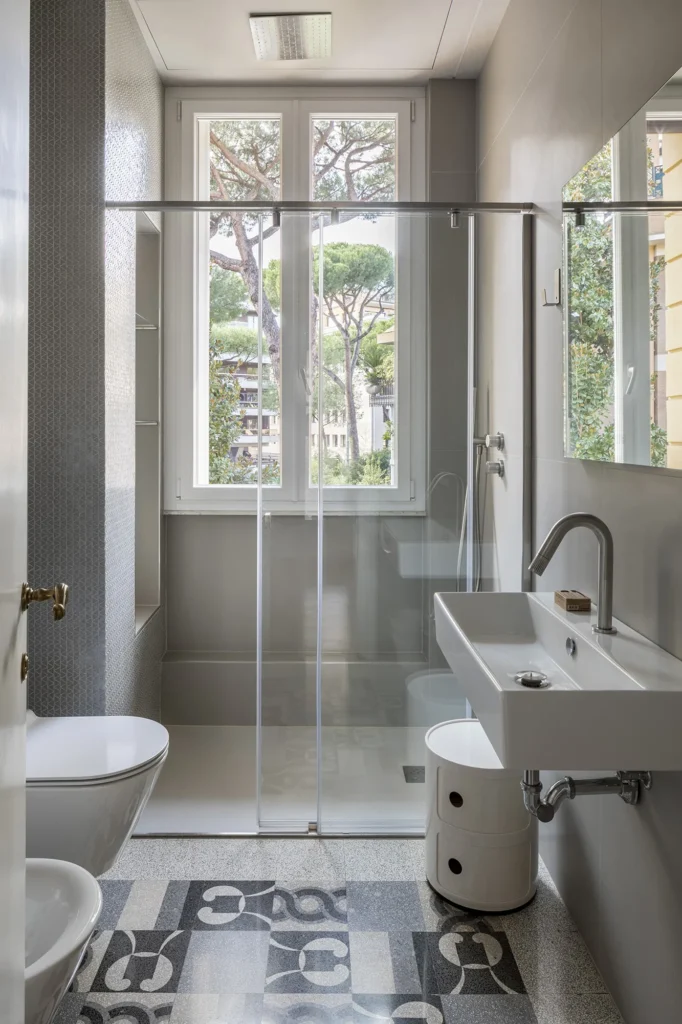
Bathroom created in Minimalist House The floor is a patchwork of original terrazzo tiles.
Compatibility with Modern Systems
Building systems present the greatest challenge. Ideally, installations should avoid running beneath the historic floor, instead using wall chases, suspended ceilings (as in one of our projects) or raised technical floors in service areas. When this is not possible, linear channels can be planned along grout lines or decorative transitions to minimise visible cuts. For heating systems, wall-mounted solutions may be preferable. Alternatively, services can run along the perimeter, with different flooring materials — such as timber — introduced in those specific areas.
The Architect’s Role in the Restoration of Terrazzo and Cement Tiles
Working with historic floors requires technical expertise, design sensitivity and the ability to mediate between conservation and contemporary needs. The best results are achieved when the historic floor is not treated as a constraint, but as a starting point for the project: an identity-defining element that informs chromatic, material and spatial choices. Amnios Studio specialises in the restoration and renovation of historic buildings in Rome, with particular attention to the conservation of historic cement and terrazzo floors. If you have uncovered original tiles in your property and wish to prioritise preservation, contact us for a free consultation.